
2026 Chevy Blazer vs Honda Passport: Comfort, Space & Features Compared
In the global mid-size SUV market, the 2026 Chevy Blazer and Honda Passport are two contenders. They have distinct styles but comparable strengths. The former appeals to urban users. It has a sporty design and balanced performance. The latter conquers the North American wilderness. It features rugged styling and a powerful V6 engine. However, when we shift focus back to everyday driving scenarios, comfort, interior space, and feature richness become key factors. Most families consider these when making a decision.
This article provides an in-depth comparison based on real-world U.S. market data. More importantly, we will explore a topic of high interest to Chinese consumers. How should you choose when these two vehicles enter the domestic market through “chinese cars for sale” channels?
The 2026 Chevy Blazer’s chassis tuning is clearly biased towards highway cruising. It features a front MacPherson, rear five-link independent suspension that filters vibrations cleanly and crisply. Our real-world test of the U.S.-spec 2LT model on Los Angeles’s Highway 101 showed that the suspension effectively smoothed out road expansion joints. The body had no unnecessary sway. This “European-style” setup makes the Blazer an excellent companion for long-distance commuters.
In contrast, the Honda Passport’s comfort follows a different logic. The 2026 model specifically reinforces the suspension system for off-road scenarios, with the TrailSport version even equipped with off-road-tuned dampers. What does this mean? On everyday paved roads, the Passport delivers a clearer road feel, with slightly more minor vibrations than the Blazer. However, once on unpaved roads, its suspension travel advantage immediately becomes apparent. It smoothly absorbs large impacts, and the body remains stable.
Quietness is another dimension of comfort. Honda has put effort into the 2026 Passport. Acoustic laminated windshields are standard across all trims. The front side windows also use sound-insulating glass. In actual experience, cruising at 80 km/h, the Passport’s cabin is at least 3 decibels quieter than the previous model. The Blazer also offers active noise cancellation technology, but its high-speed wind noise control falls slightly short of Honda’s.
Seat comfort: The Blazer’s seat padding is relatively soft. It offers a “sinking-in” sofa feel for short trips. The Passport’s seats provide stronger support. This reduces fatigue on long drives. The difference in orientation is clear—the Blazer caters to commuters, while the Passport pleases long-distance travelers.
2026 Chevy Blazer: Maximum cargo space of 64.2 cubic feet (approximately 1,818 liters), second-row legroom of 39.6 inches.
Honda Passport: Honda hasn’t released official full data. However, based on previous models and actual measurements by North American media, its rear legroom and trunk depth are significantly superior to the Blazer’s.
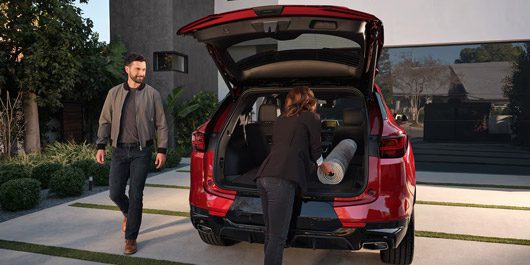

The real-world experience varies greatly. The Blazer’s trunk opening is relatively narrow, and the load floor is high. In our test, after placing two 28-inch suitcases and a stroller, the remaining space was already tight. The Passport, however, truly demonstrates the power of Honda’s “MM Concept” (man-maximum, machine-minimum). Honda designed a large hidden storage compartment under the trunk floor. It can hold six 1-gallon (about 3.8-liter) water bottles flat. With the second-row seats folded down, the Passport forms a nearly flat floor, allowing an adult to lie down without pressure.
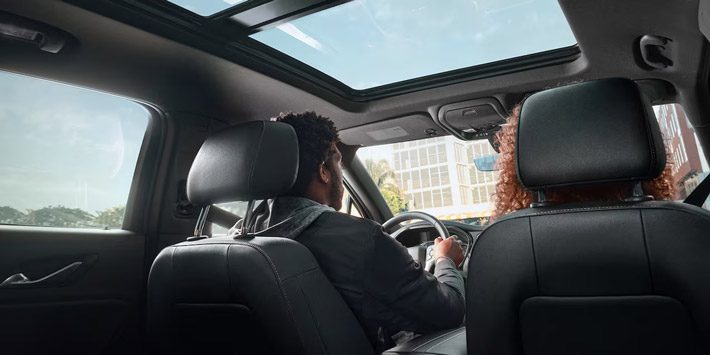
Second-row seating experience: Does the Blazer’s headroom (38.6 inches) slightly surpass the Passport’s? The actual feel, however, favors the Passport. The reason lies in the Passport’s larger side window area and rearward-shifted C-pillar. These give the rear seats a much more open feel than the Blazer. For families with child safety seat needs, the Passport is undoubtedly the more comfortable choice.
The 2026 Chevy Blazer emphasizes “technology equality.” It comes standard with a 10.2-inch floating center touchscreen, wireless CarPlay/Android Auto, and a Wi-Fi hotspot. But note these shortcomings. Adaptive cruise control is only available on higher trims and is not full-speed range. A 360-degree panoramic view requires optional selection. A wireless charging pad is absent on lower trims.
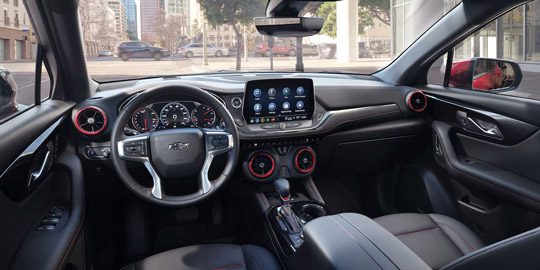
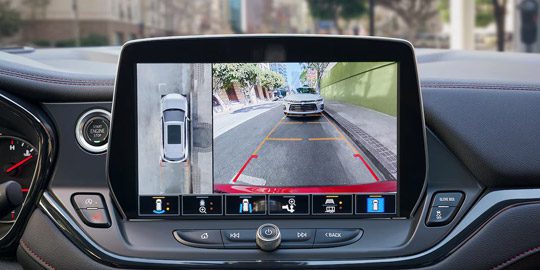
In contrast, we can describe the 2026 Honda Passport’s feature strategy as “class-defying.” Standard equipment across all trims includes several features. These are: a 12.3-inch fully digital instrument cluster, wireless CarPlay/Android Auto, wireless phone charging, front seat heating, adaptive cruise control (with stop-and-go functionality), and traffic sign recognition. The TrailWatch off-road imaging system is even unique in its class. It eliminates front blind spots through multiple cameras. This system offers excellent compensation for the visibility shortcomings caused by its rugged design.
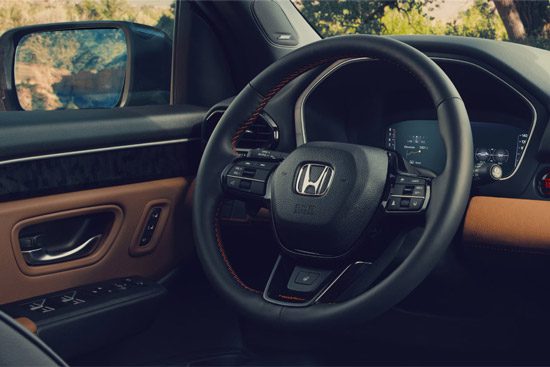
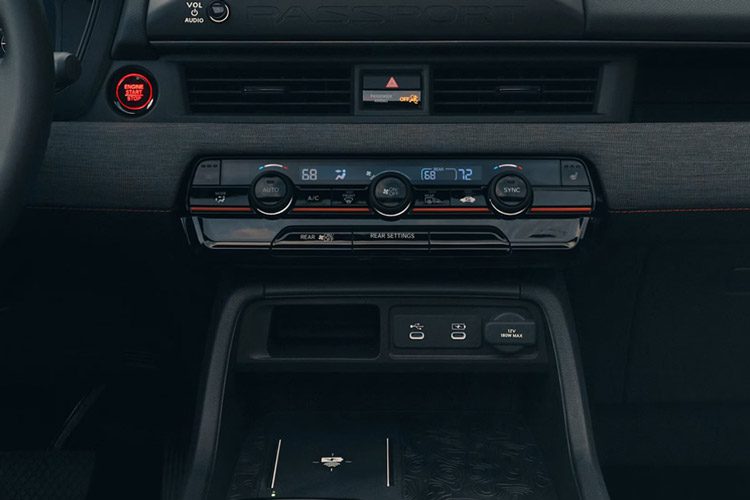
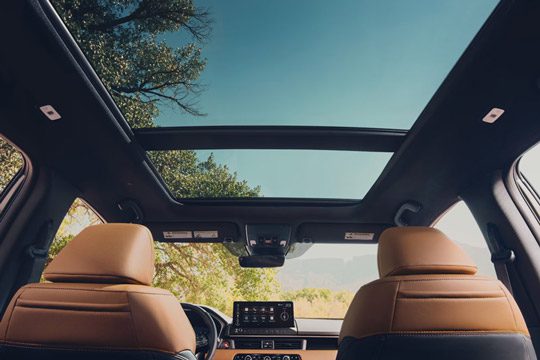
A detail reveals the generational gap. The Blazer has only 4 driving modes. The Passport offers 7, including dedicated off-road modes like snow, mud, and sand. This isn’t just a simple difference in quantity; it reflects the capability of the vehicle’s underlying electronic architecture.
In terms of pricing, based on the U.S. market:
2026 Chevy Blazer: Starting price $34,200 (approximately $36,095 including destination fee), top-spec RS AWD version around $46,400.
2026 Honda Passport: Starting price $44,950, top-spec TrailSport Elite up to $52,650.
The price difference is a substantial $10,000. Honda’s pricing strategy is clear. The Passport no longer competes with ordinary family SUVs. Instead, it targets high-value users as a “professional outdoor tool.”
SAIC-GM has already introduced the 2026 Chevy Blazer for local production. You can experience and purchase it at any Chevrolet 4S store across China. This is a legitimate “chinese cars for sale” channel, complete with full warranty, localized tuning, and connected car services.
However, the Honda Passport is an entirely different story. As of now, Honda China has no official plans for introduction or local production. This means that if you want to own this rugged V6 SUV in mainland China, you have only one option. That is the parallel import channel.
What is the reality of parallel imports?
The U.S.-spec Passport starts at around $45,000. However, after parallel import to China, the final transaction price generally ranges from 550,000 to 650,000 RMB. This is approximately $76,000 to $90,000.
No official warranty; repairs depend on importers or third-party service providers.
The infotainment system is the U.S. version, with navigation, voice commands, and other functions ill-suited for the domestic environment.
This raises a core question: Is it worth spending an extra 200,000+ RMB for a Passport?
We believe only two types of people suit it:
Hardcore outdoor enthusiasts need 5,000 lbs towing capacity, true torque-vectoring AWD, and 8.3 inches of ground clearance. They cannot let go of their V6 passion.
Niche collectors seek rarity and don’t want to blend in with the sea of Highlanders and Aviators on the road.
For 99% of Chinese families, the 2026 Chevy Blazer is a more rational and practical “chinese cars for sale” option.
| Comparison Dimension | 2026 Chevy Blazer | Honda Passport (2026 U.S.-spec) |
| Core Comfort Advantage | Excellent road vibration filtering, soft seats | Outstanding quietness, long suspension travel |
| Space | Adequate, meets mid-size SUV standards | Class-leading, magic-level storage design |
| Feature Value | Basic smart features standard across trims | High-end comfort/off-road features democratized |
| Power | 2.0T 4-cylinder (228 hp) | 3.5L V6 (285 hp) |
| U.S. Starting Price | $34,200 | $44,950 |
| China Market Availability | Official local production, convenient | Parallel import, high barrier |
Advice for U.S. consumers: If you spend 90% of your time commuting in the city, the Blazer is a highly cost-effective choice. If you truly venture into the Mojave Desert or Colorado Rockies on weekends, the Passport is worth the $10,000 premium.
Advice for Chinese consumers: The 2026 Chevy Blazer is a tangible and reliable part of the official “chinese cars for sale” landscape. As for the Passport—it’s a great vehicle, but it’s far across the ocean. Unless you are willing to pay a steep premium for sentiment, there’s no need to force it.

