

How can I improve my car AC performance in summer?
In the global hardcore SUV market, the 2026 Ford Bronco is undergoing an unprecedented evolution. This legendary model was born in 1966. On its 60th anniversary, it presents a distinctly bifurcated landscape. Specifically, the North American market remains committed to traditional fuel power and mechanical four-wheel drive. In contrast, the Chinese market has pioneered a new chapter. With its independently developed “ZhiQu Bronco,” it leads in electrification and advanced intelligent driving.
This article adopts a global perspective. It deeply analyzes the interior innovations, technological configurations, and off-road performance of the 2026 Ford Bronco. Importantly, the new energy version was spearheaded by a Chinese automotive engineering team. Consequently, it is now not only sold domestically in China but has also garnered attention worldwide through parallel export channels. As a result, cases of 2026 Ford Bronco, Chinese cars for sale to markets in the Middle East, Europe, and Australia are rapidly increasing.
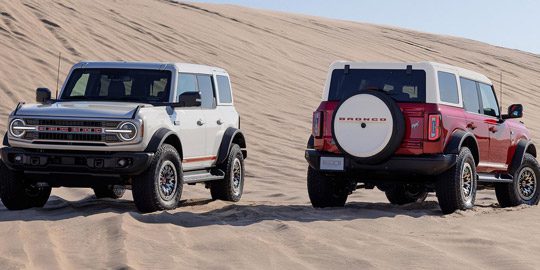
The interior design of the 2026 Ford Bronco reveals clear market differentiation. However, this differentiation isn’t about cost-cutting. Instead, it is a precise definition tailored to user habits in different regions.
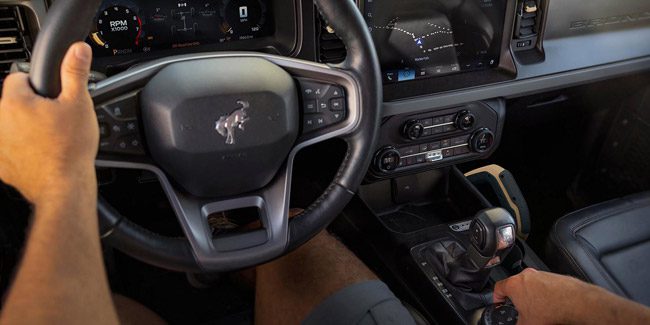
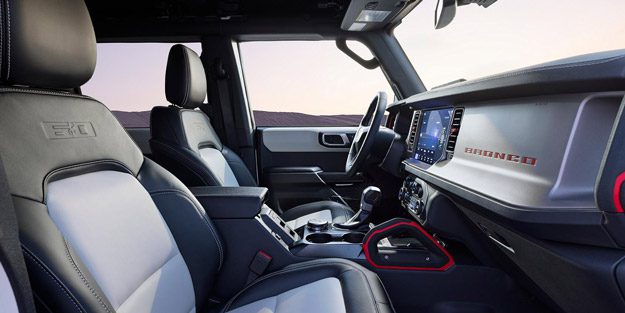
In the U.S. and Canadian markets, entry-level versions continue the rugged DNA. For instance, the 2026 Bronco Big Bend remains washable and durable.
Firstly, seat materials offer marine-grade vinyl leather. This provides exceptional waterproofing. Thus, you can climb back in covered with mud and hose down the cabin without issue. Additionally, floor mats are upgraded to rubber flooring with drain plugs, replacing plush carpeting. This design is incredibly practical. During snowy seasons in Manitoba, Canada, there’s no need for mats. You can simply drain the melting snow directly.
Secondly, the four-door version boasts optimized space utilization. According to Car and Driver test data, rear legroom in the four-door version is much more generous. Therefore, long-distance travel is comfortable for adults. Meanwhile, the two-door version retains a four-seat layout. Its rear seats are adequate for emergencies. However, if you want to store removed doors inside, the two-door version requires folding down the rear seats.
Regarding interior materials, hard plastic remains mainstream. While this may not sound luxurious, the logic is clear. This is an off-roader designed for roof removal and water fording. Genuine leather and solid wood would seem delicate in such scenarios. Consequently, Ford’s U.S. engineers insist that UV resistance, scratch resistance, and noise-free operation are far more important than soft-touch surfaces.
Now, turning our focus to China. The Ford China design team has completely overhauled the North American interior plan. They introduced a brand-new design language called the “Digital Cockpit.”
Sitting in the driver’s seat, the 15.6-inch 2.5K Mini-LED floating screen is the immediate focal point. Its display resolution far exceeds the North American 12-inch version. Moreover, it features special anti-glare coating for high visibility under strong light. The instrument cluster is upgraded to an 8.8-inch fully digital screen. This is complemented by a 70-inch AR-HUD. Notably, this AR-HUD isn’t just for speed projection. It can “draw” navigation arrows directly onto the real road ahead. Thus, it indicates turns or obstacles without the driver ever taking their eyes off the road.
More importantly, the interaction logic is deeply localized. The Qualcomm Snapdragon 8255 chip powers the entire system. This enables highly accurate four-zone voice recognition. For example, a rear passenger saying “I’m cold” will automatically adjust the rear climate temperature. No manual input is needed. Furthermore, Face ID recognition triggers upon entry. It automatically adjusts seat positions, mirror angles, and even ambient lighting colors to preset preferences.
The Chinese version also incorporates several thoughtful touches. Two USB-C ports are reserved inside the passenger-side glove box. Another is hidden at the rear of the center console. These are designed for charging drones, GoPros, or two-way radios. Even more surprisingly, the tailgate integrates an induction cooktop and folding table. This is not a concept car gimmick. It is an original factory production accessory. Simply open the tailgate, plug in the external discharge gun, and you can boil water or brew coffee.
A 7.5-liter thermoelectric cooler/warmer is also standard on higher trims. It can hold four bottles of iced cola in summer. In winter, it keeps drinks warm. Meanwhile, the 256-color ambient lighting shifts hues according to the driving mode.
Summary: If you purchase the 2026 Bronco in North America, the interior keywords are durability, functionality, and high adaptability. Conversely, if you are focusing on the 2026 Ford Bronco, Chinese cars for sale version, the interior keywords are immersion, intelligence, and camping-friendliness. Ultimately, neither approach is superior. They are precise reflections of different market demands.
The divergence in technology configurations is even more pronounced than in the interior. This isn’t due to Ford favoritism. Rather, it stems from fundamentally different definitions of “technology” held by users in China and the U.S.
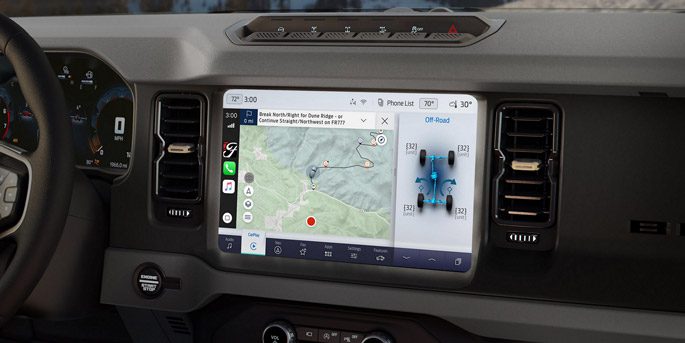
In the U.S. market, the 2026 Bronco comes standard with a 12-inch touchscreen. It features the SYNC 4 system across all trims, supporting wireless Apple CarPlay and Android Auto. This system’s strengths are paramount: stable, smooth, and lag-free. It lacks flashy animations. However, it handles navigation projection, audio switching, and vehicle status monitoring with utmost reliability.
An optional 12-speaker B&O sound system provides ample power. It overcomes wind noise at highway speeds. Of course, wind noise remains an issue. Removing the roof and doors is a key selling point. Americans readily accept that freedom comes with a bit of wind roar.
Regarding driver assistance, the U.S. version is relatively restrained. Automatic emergency braking, auto high beams, and blind-spot monitoring are standard or available on higher trims. However, there’s no LiDAR and no urban NOA. Ford’s engineers believe that the primary task of electronics in a hardcore off-roader is not to interfere. Instead, it should avoid making decisions for the driver.
The Chinese ZhiQu Bronco operates on an entirely different logic. It features 31 high-precision sensors. These include forward-facing LiDAR, millimeter-wave radar, and multiple HD cameras. This hardware foundation enables high-speed NOA (Navigate on Autopilot) assistance.
In practical experience, the system’s timing for automatic lane changes is remarkably adept. It behaves like a seasoned personal chauffeur—neither jerky nor hesitant. More practically useful are remote parking and phone-as-key entry. Encounter a tight spot, exit the vehicle, and use your phone. The car then steadily parks itself. For a hardcore SUV nearly 2 meters wide, this is an essential daily feature.
The 540° transparent chassis is also standard on the Chinese version. Cameras not only stitch together the under-vehicle image. They also predict trajectory lines based on wheel steering. Consequently, navigating narrow barriers or climbing gravel slopes becomes clearly visible on the center screen. This prevents wheel scuffs even for novices.
Off-road assistance functions are equally intelligent. The All-Terrain Vision Scanning system can identify road surfaces ahead—such as sand, mud, or snow. Then, it automatically switches to the corresponding G.O.A.T. mode in milliseconds. Additionally, the ultra-low speed crawl mode locks the speed at 2 km/h. You simply steer, and the vehicle handles throttle and braking.
Summary: The U.S. spec pursues precision, reliability, and non-intrusiveness. In contrast, the Chinese spec pursues versatility, convenience, and lowering the barrier to entry. Crucially, the Chinese automotive engineering team independently developed the entire intelligent driving solution. This explains why, when the 2026 Ford Bronco, Chinese cars for sale overseas, local reviewers consistently comment that its “intelligence level far exceeds the U.S. spec version.”
By 2026, the Ford Bronco family has effectively diverged into three technical paths:
These three paths each cater to completely different off-road scenarios.
The North American 2026 Bronco still offers two engine options. These are the 2.3L EcoBoost four-cylinder (300 hp) and the 2.7L twin-turbo V6 (330 hp). Transmission choices include a 7-speed manual (four-cylinder only) or a 10-speed automatic.
The Sasquatch package remains the essence. It bundles 35-inch mud-terrain tires, Bilstein shocks, front and rear electronic differential locks, and a disconnecting stabilizer bar. Measured performance shows the V6 Wildtrak hitting 0-60 mph in 6.2 seconds. This is more than ample power for such a boxy vehicle.
Off-road geometry parameters also maintain top-tier levels. Approach, departure, and breakover angles vary depending on the package. The highest spec easily conquers most obstacles on the Rubicon Trail.
Nevertheless, shortcomings persist. These include significant high-speed wind noise and subpar fuel economy. EPA combined fuel economy is 17-20 MPG. Consequently, range on a full tank is unremarkable.
Turning focus back to the ZhiQu Bronco. This is a unibody SUV. However, it is certainly no “soft roader.”
Objectively speaking, unibody construction cannot withstand prolonged, high-intensity torsional stress like body-on-frame. However, 95% of Chinese off-road users never tackle extreme rock crawling. Their needs are different. They want to drive easily up to a mountain campsite on weekends without getting stuck. They also want electricity available upon arrival. The ZhiQu Bronco excels at these tasks.
The 2026 Bronco Sport receives an updated Bronze Appearance package. Its powertrain is upgraded to a 2.0T + 8AT (249 hp), with standard intelligent four-wheel drive. The Badlands version features a rear torque vectoring differential. It also includes an Off-Road One-Pedal mode. Lifting off the accelerator applies strong deceleration. This eliminates frequent foot-switching between pedals on rough terrain.
Its positioning is very clear. It is not for rock crawling in Moab. However, it is more than capable of handling snow, mud, and gravel roads. The U.S. starting price is approximately $31,590 (Big Bend version). Thus, it offers exceptional value.
It is particularly important to note: The Chinese version ZhiQu Bronco is currently produced by JMC-Ford Technology. It is not officially exported on a large scale. However, thanks to its highly competitive pricing and configurations, a considerable number of vehicles are flowing through parallel trade channels. These reach markets in the Middle East, Russia, Australia, and Southeast Asia. This explains why you frequently see information about 2026 Ford Bronco, Chinese cars for sale on overseas social media. The Chinese-made Bronco is becoming a new topic of conversation in the global off-road community.
The 2026 Ford Bronco family is more diverse than ever before.
The U.S.-spec fuel version remains the spiritual icon for traditional off-road enthusiasts. It is rugged, reliable, and highly customizable. It offers the irreplaceable ritual of removing doors and roof.
In contrast, the Chinese version ZhiQu Bronco showcases a completely new possibility. An off-roader can be comfortable, intelligent, and electrified. It can also serve as a mobile camping base. It does not pursue climbing limits. Instead, it aims for freedom across all scenarios.
Finally, the Bronco Sport, with its more accessible price point, allows more young families to embrace the Bronco lifestyle.

