
2026 Lexus TX 350 Review: Specs, Price, Features & Pros and Cons
Once renowned worldwide for its distinctive design, the compact SUV Toyota C-HR is ushering in its “second life” in 2026. This time, it has completely phased out internal combustion engines, making a comeback as a pure electric platform-based “cool coupe SUV,” sparking a new wave of attention across major global markets. This article provides an in-depth analysis of its features, performance, energy consumption, and global market positioning, addressing the core question of whether it is worth buying.
The most notable change in the 2026 C-HR lies in its complete transformation of the powertrain system. Toyota has formulated a clear global dual-strategy for it:
Electric Pioneer (US, European, and Japanese Markets): In North America, Europe (e.g., Ireland, France), and Japan, the new-generation C-HR (known as the C-HR+ in some markets) has fully evolved into a pure electric vehicle (BEV). It is built on the e-TNGA pure electric architecture co-developed by Toyota and Subaru, sharing core three-electric technology with the bZ4X, yet featuring a more personalized design.
Hybrid Mainstay (Select Markets): In markets like China and parts of Europe, consumers are expected to continue having access to Toyota’s mature and reliable Hybrid (HEV) and Plug-in Hybrid (PHEV) versions. These models will continue to be developed based on the TNGA architecture, offering excellent fuel economy.
The table below clearly illustrates the primary powertrain and pricing strategies across different global markets (prices have been uniformly converted to USD based on exchange rates at the time of publication):
| Market/Region | Main Powertrain Type | Starting Price (Approx. USD) | Core Powertrain Parameters & Notes |
| US Market | Pure Electric (BEV) | $37,000 | Dual-motor AWD, 338 hp, 0-96km/h acceleration ~5 sec, EPA-estimated range ~466 km (~290 miles). |
| European Market (e.g., Ireland) | Pure Electric (C-HR+) | To be officially announced | Offers two battery capacities with single/dual motor options. Longest WLTP range exceeds 600 km. Dual-motor version: 0-100km/h acceleration in 5.2 sec. |
| European Market (e.g., UK) | Hybrid / PHEV | From ~$38,300 | Primarily features 1.8L/2.0L Hybrid and PHEV. PHEV pure electric range ~66 km (~41 miles). |
| Chinese Market (Estimate) | Hybrid (Likely Main Option) | Not Announced (Pending official confirmation) | Mature hybrid versions likely prioritized for introduction. Both GAC Toyota and FAW Toyota may potentially introduce corresponding models (e.g., Yize IZOA), pending official confirmation. |
The new vehicle features bold innovations in styling. Its dimensions have been comprehensively enlarged, with length, width, and height reaching approximately 4520 x 1870 x 1595 mm. The wheelbase has significantly increased to 2750 mm, even surpassing the current RAV4, laying a foundation for interior space.
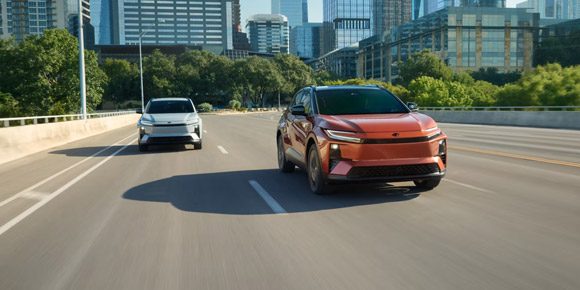
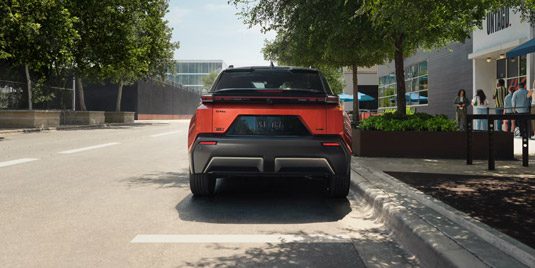
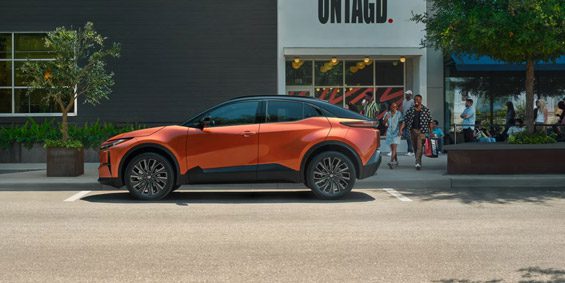
Design-wise, it inherits the first-generation’s “diamond cutting” language but with sharper lines. The front fascia features split-type headlights and a semi-enclosed grille, while the rear sports popular full-width light clusters. The fastback roofline adds a sense of dynamism. The overall aesthetic resembles a vehicle from the future, and the drag coefficient has been optimized to help improve range.
Inside the cabin, traditional physical buttons have been significantly reduced, replaced by a digital cockpit centered around two screens.
Technology Features: Higher trim levels are equipped with a massive 14-inch central touchscreen and a separate digital instrument cluster. The infotainment system supports wireless Apple CarPlay and OTA updates. Notably, Toyota has integrated climate control temperature knobs into physical dials on both sides of the screen, balancing convenience with modern design.


Safety Systems: The “Toyota Safety Sense 3.0” suite comes standard across the lineup, including a Pre-Collision System with pedestrian detection, Full-Speed Range Dynamic Radar Cruise Control, Lane Tracing Assist, and more. Higher trims also offer a 360-degree panoramic view monitor, Blind Spot Monitor, and Advanced Parking Support.
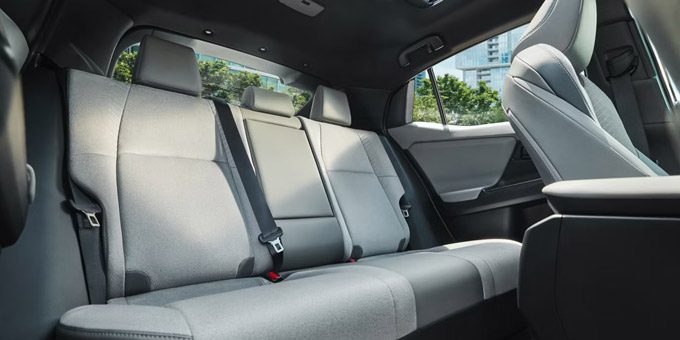
Interior Ambiance: Interior materials and build quality are excellent, but the style leans towards a cool aesthetic. Extensive use of dark grey and black materials, while complemented by 64-color ambient lighting, might make rear-seat passengers feel the atmosphere is somewhat subdued.
Although the longer wheelbase brings significant improvement in legroom, the C-HR’s signature fastback styling still imposes limitations on rear headroom and side window visibility. Taller passengers may find the rear seats somewhat cramped.
Storage space performance is adequate:
Cargo Area: The pure electric version offers approximately 416 liters (European standard) or 25.4 cubic feet (~719 liters, US standard), sufficient for daily needs.
In-Cabin Storage: The front boasts spacious door pockets, a center console with wireless charging, while the rear is equipped with USB-C ports and storage nets, showing thoughtful consideration for details.
This is the core competitive edge of the 2026 pure electric C-HR.
Power Performance: Taking the US-spec version as an example, the dual-motor setup delivers a combined output of up to 338 horsepower, providing brisk acceleration. The 0-96 km/h (0-60 mph) sprint takes only about 5 seconds, rivaling many performance sedans.
Range and Charging: It is equipped with a large 74.7 kWh battery pack. Depending on the testing standard, its range is approximately 466 km (290 miles) under the EPA cycle, while the long-range version can exceed 600 km under the more lenient WLTP standard. It supports DC fast charging, capable of replenishing the battery from 10% to 80% in about 30 minutes, and is compatible with Tesla’s open Supercharger network in North America (NACS standard).
Driving Refinement: The characteristics of the electric motor deliver an exceptionally smooth and quiet driving experience. The chassis tuning leans towards comfort, effectively filtering out road imperfections. However, it is not focused on driving engagement during spirited cornering, being better suited for relaxed urban cruising.
Regarding Hybrid Versions: If a hybrid version is available in your market, its core advantage will be exceptional fuel efficiency. The 2.0L hybrid system can achieve a combined fuel consumption as low as approximately 4.5L/100km. Furthermore, Toyota’s hybrid systems are renowned for their high reliability and smooth operation.
Overall, the 2026 Toyota C-HR is a vehicle with an extremely distinct personality.
It’s Worth Buying If You:
Consider Carefully If You:
The 2026 Toyota C-HR has accomplished a successful self-reinvention. It has evolved from a fashionable niche internal combustion vehicle into a technologically advanced, high-performing, and still stylish pure electric (or hybrid) SUV. It offers an experience beyond its class in design, energy efficiency, and technology, while also inheriting the characteristic of sacrificing some practicality for its form.
Ultimately, choosing it is more like a lifestyle statement: you are willing to accept a slight compromise in spatial practicality for unique design and efficient electric performance. It is recommended that before making a decision, you consider the actual supply situation in your local market (paying particular attention to the specific configurations for the 2026 Toyota C-HR, Chinese cars for sale) and personally visit a dealership for a test drive to experience firsthand whether it is the right vehicle for you.

