


2026 Hyundai Palisade Hybrid Review: A Smarter Three-Row SUV for Families
The luxury electric vehicle market is undergoing unprecedented transformation. In 2026, competition within this segment has intensified further, with major brands launching updated and revamped models.
The BMW i7, as the flagship model in the brand’s electrification strategy, has drawn significant attention. The 2026 i7 has received the most extensive mid-cycle refresh in BMW’s history. It incorporates the next-generation technologies from the Neue Klasse. This is not merely a simple annual update. It is a comprehensive revolution from the inside out.
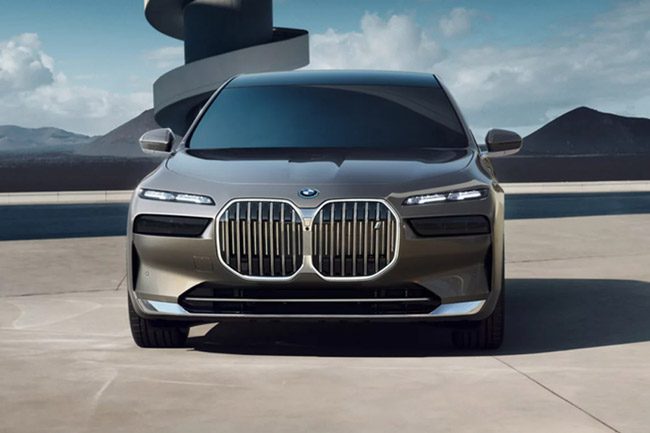
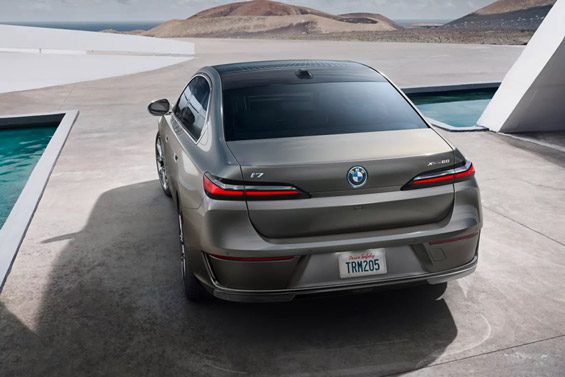
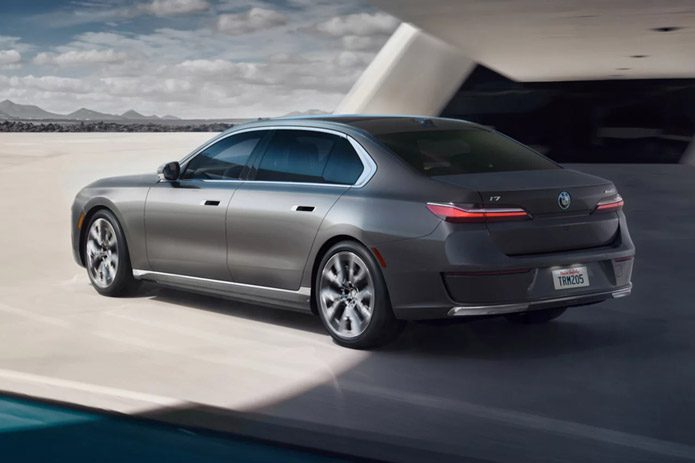
So, is this car truly worth purchasing? How does it compare to the Mercedes-Benz EQS, Lucid Air, and Tesla Model S in terms of strengths and weaknesses? This article will provide you with a comprehensive and objective buying guide.
If you are considering a luxury electric vehicle, this analysis is not to be missed. Furthermore, the selection of electric vehicles globally is becoming increasingly diverse. Many consumers are also paying attention to information about chinese cars for sale, as Chinese brands have made significant strides in the EV sector in recent years. Nevertheless, the i7, as a representative of German luxury, still possesses an irreplaceable and unique charm.
The new model is equipped with an all-new 112.5 kWh battery pack, a notable increase compared to the 105.7 kWh pack in the previous generation. The battery utilizes sixth-generation cylindrical cell technology developed in collaboration with Rimac. This technology substantially enhances energy density.
The maximum range of the i7 reaches 452 miles (approximately 728 kilometers) under the WLTP standard, an increase of nearly 70 miles over the outgoing model. This figure is essentially on par with the Mercedes-Benz EQS, solidifying the i7’s position in the range competition.
It is worth noting that range performance varies across different versions. Both the i7 50 xDrive and 60 xDrive can achieve a WLTP range of 728 kilometers. The top-tier M70 xDrive has a slightly shorter range of 686 kilometers.
For daily commuting and long-distance travel, this range performance is entirely sufficient. Even under the U.S. EPA testing standard, the i7’s range falls between 285 and 314 miles. This means you can easily make a round trip between Los Angeles and Las Vegas without range anxiety.
The improvement in charging speed is another major highlight of the 2026 i7. The new model supports a maximum DC fast-charging power of 250 kW. Compared to the previous generation’s 195 kW, this represents an increase of more than a quarter.
Charging from 10% to 80% takes approximately 30 minutes. This is undoubtedly a huge benefit for long journeys.
For home charging, the i7 supports 22 kW AC slow charging. A full charge takes about 5 to 6 hours, suitable for overnight charging scenarios.
However, compared to some competitors, the i7 still has some gaps. The Audi e-tron GT supports 320 kW fast charging, and the Porsche Taycan similarly benefits from the ultra-high charging efficiency provided by its 800-volt high-voltage architecture. The i7 continues to use a 400-volt electrical system, which means it is not the market leader in absolute peak charging speed.
If you seek the perfect fusion of technology and luxury, the interior of the 2026 i7 will deeply captivate you. This is the most eye-catching part of this refresh.
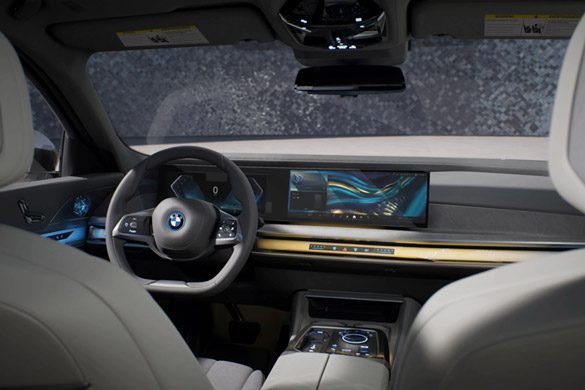
BMW has thoroughly reshaped the i7’s cabin. The new Panoramic iDrive system replaces the traditional instrument cluster layout. Core driving information is projected onto a continuous panel at the base of the windshield, spanning the entire width between the A-pillars. This design allows the driver’s gaze to remain focused on the road ahead, significantly enhancing driving safety.
The central control area features a 17.9-inch central touchscreen. Its unique parallelogram shape runs BMW’s latest iDrive X operating system. Additionally, the new model comes standard with a front passenger entertainment screen for the first time, allowing passengers to watch videos, play games, or even conduct video calls while on the move.
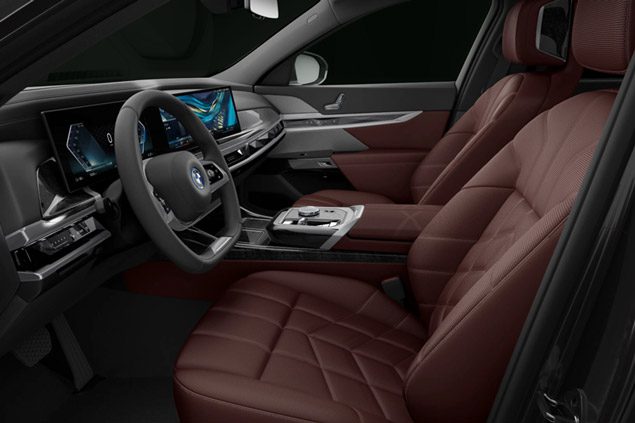
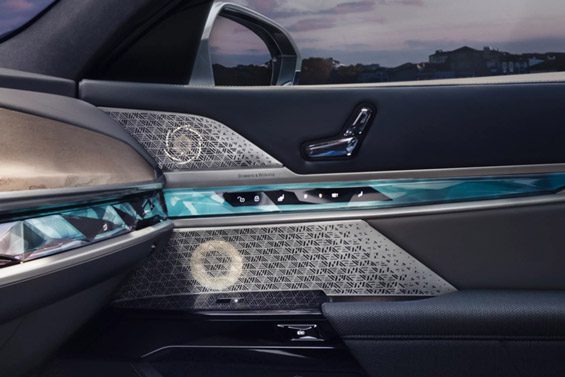
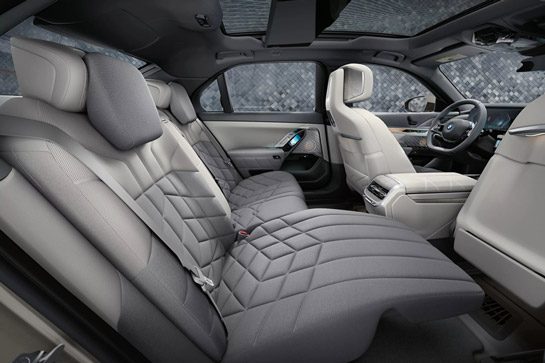
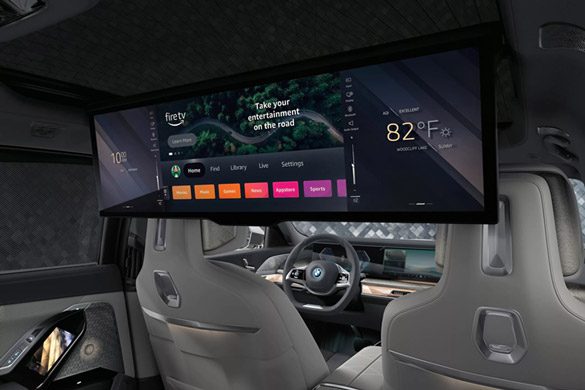
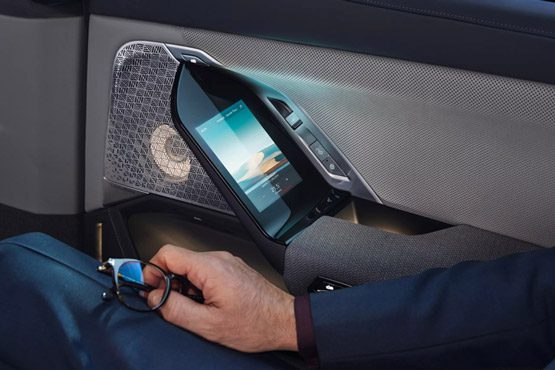
The experience for rear-seat passengers is equally upgraded. The optional 31.3-inch 8K Theatre Screen supports Dolby Atmos sound and enables Zoom video conferences. Sitting in the back, you can transform the vehicle into a mobile office or private cinema. Integrated 5.5-inch touchscreen controls in the rear door armrests allow passengers to directly adjust seats, climate control, audio settings, and more.
In terms of luxury, the i7 achieves the extreme. The cabin features extensive use of leather, deep-pile carpeting, and crystal glass decorative elements. Rear legroom reaches 42.8 inches (approximately 108 centimeters), offering an exceptionally spacious and comfortable seating experience. The authoritative British media outlet Parkers commented: “The i7’s interior is more luxurious than the EQS and S-Class, beginning to challenge the levels of Bentley and Rolls-Royce.”
The 2026 i7 offers three powertrain configurations, catering to different needs:
| Model | Power | 0-100 km/h Acceleration | Drive Type |
| i7 50 xDrive | 456 hp | 5.5 seconds | Dual-Motor AWD |
| i7 60 xDrive | 545 hp | 4.8 seconds | Dual-Motor AWD |
| i7 M70 xDrive | 680 hp | 3.8 seconds | Dual-Motor AWD |
Dual-motor all-wheel drive is standard across the entire lineup. Even the entry-level 50 xDrive delivers impressive acceleration performance. If you seek ultimate performance, the M70 xDrive can accelerate from 0 to 100 km/h in just 3.8 seconds, providing supercar-like thrust.
Regarding the driving feel, the i7 leaves a profound impression. MotorTrend wrote in its review: “The i7’s ride quality rivals that of a Rolls-Royce. It is a mobile luxury lounge, unbelievably quiet.” Despite weighing over three tons, the i7 demonstrates surprising handling agility thanks to rear-wheel steering and adaptive suspension.
However, the i7 is not without flaws. Car and Driver points out that the i7 relies excessively on touchscreen controls, lacking physical buttons and knobs, making some functions less intuitive to operate. Additionally, winter range performance is not ideal, a common pain point for electric vehicles.
The i7 and EQS are direct competitors, each with its own strengths.
| Comparison Dimension | BMW i7 | Mercedes-Benz EQS |
| WLTP Range | 728 km | Approx. 780 km |
| Charging Power | 250 kW | 200 kW |
| Interior Style | Luxurious texture, nearing Rolls-Royce | Tech-forward, dazzling Hyperscreen |
| Rear-Seat Experience | Excellent, Theatre Screen + Massage Seats | Good, but not as opulent as the i7 |
| Driving Feel | Balance of comfort and handling | Extreme comfort-oriented |
To put it simply: If you prioritize the opulence of rear-seat accommodations and overall interior quality, the i7 is the more worthy choice. If you seek maximum range and avant-garde technology, the EQS might be more suitable for you.
The Lucid Air has been hailed as the “king of luxury EVs.” It is indeed astonishing in terms of range and performance.
The Air Grand Touring version offers a range exceeding 800 kilometers (WLTP), about 70 kilometers more than the i7. The top-spec Air Sapphire version boasts over 1,200 horsepower and accelerates from 0 to 100 km/h in under 2 seconds.
However, the i7’s advantages lie in its brand heritage and build quality details. BMW’s assembly craftsmanship and interior materials are more solid. The i7’s sound insulation, seat comfort, and brand service network are all more mature. Moreover, the i7’s rear-seat experience is markedly superior to that of the Air. This is crucial for consumers focused on business reception or family travel.
The Model S was once the benchmark for luxury electric vehicles. It holds advantages in acceleration performance and the Supercharger network. The acceleration capability of the Plaid version is unmatched. Tesla’s Supercharger network offers extensive coverage and ease of use globally.
However, the i7 comprehensively surpasses the Model S in interior quality and luxury feel. Car and Driver’s review notes: “The i7 outperforms Tesla in quietness, ride comfort, and sense of technology, and its interior materials are more opulent.” If you care about the experience of the “passengers” and not just the “driver,” the i7 is undoubtedly the better choice.
The Taycan is positioned more towards sportiness and driving pleasure. Its precise handling and sharp steering excel on the track.
The i7, on the other hand, emphasizes the comfort experience of a large luxury sedan. If you are a driving enthusiast who revels in speed and passion through corners, the Taycan will better suit your taste. If you need a large flagship sedan that balances business travel and family use, the i7 offers a more well-rounded package.
1. Value Choice: i7 50 xDrive
Starting at approximately $107,000 (US market), it offers 456 hp, all-wheel drive, and 728 km of range. For most consumers, the power and configuration of this version are entirely adequate. It encompasses the core essence of the i7—opulent interior, advanced technology, and excellent comfort.
2. Best Recommendation: i7 60 xDrive
Starting at approximately $126,000 (US market), power increases to 545 hp, achieving 0-100 km/h in just 4.8 seconds. Both Car and Driver and MotorTrend recommend the 60 xDrive as the version most worth buying. It perfectly balances performance, range, and price, and comes standard with many premium features, including the Luxury Rear Seating Package.
3. Ultimate Performance: i7 M70 xDrive
Starting at approximately €182,000 (European market) or $169,000 (US market), it boasts 680 hp and a 3.8-second 0-100 km/h acceleration capability. If you pursue ultimate power performance and have ample budget, the M70 will not disappoint.
The pricing for the 2026 i7 has seen an increase. In the European market, the starting price has risen from €115,900 to €121,400. In the US market, the i7 50 xDrive starts at $107,550.
However, according to data from Kelley Blue Book, the actual transaction prices for the i7 are currently generally $2,875 to $4,675 below the Manufacturer’s Suggested Retail Price. If you are adept at negotiation, you may secure a more favorable deal.
It is worth noting that competition in the global electric vehicle market is increasingly fierce. Many consumers, while considering luxury EVs, are also paying attention to chinese cars for sale. Chinese brands such as BYD, NIO, and Zeekr are rapidly expanding into overseas markets. Their products demonstrate strong competitiveness in terms of range, intelligence, and value for money. This trend has also made traditional luxury brands more cautious with their pricing strategies.
According to Caredge’s calculations, the total five-year cost of ownership for the BMW i7 is approximately $152,108. This includes expenses such as depreciation, insurance, maintenance, and charging. For reference, the ownership costs for the Mercedes-Benz EQS and Porsche Taycan in the same class are roughly equivalent. Maintenance costs for EVs are generally lower than for gasoline vehicles, but insurance premiums tend to be relatively higher.
The answer is: Yes, but with conditions.
If you fall into the following categories of consumers, the i7 is an ideal choice:
If you meet the following criteria, you might need to consider other options:
In one sentence: The 2026 BMW i7 is one of the most well-balanced and mature products currently available in the luxury EV market. It achieves top-tier levels in range, interior, comfort, and technology. If you recognize BMW’s brand value and are willing to pay for this “German luxury,” the i7 is absolutely worth serious consideration. After a test drive, you are very likely to be won over.

