
Kia Telluride Hybrid vs Toyota Grand Highlander Hybrid: Which SUV Is Better?
As the global new energy vehicle market continues to expand, every electric vehicle owner now focuses on how to efficiently configure regenerative braking and energy-saving modes. This article will comprehensively analyze the setup methods, brand-specific differences, and practical benefits of these two core functions. It will help you maximize driving range and reduce vehicle operating costs.
Regenerative braking is a core technology. During vehicle deceleration or braking, it converts kinetic energy—which would otherwise dissipate as heat—into electrical energy. The system then stores this energy back into the traction battery. Simply put, when you release the accelerator pedal or lightly press the brake pedal, the drive motor reverses its role and functions as a generator. It captures the vehicle’s coasting energy and recharges the battery. This process improves overall energy efficiency.
Regenerative braking extends driving range. It also reduces wear on mechanical brake components and lowers maintenance costs. For millions of electric vehicle owners worldwide, this technology has become an indispensable part of daily driving. According to market forecasts, the global regenerative braking system market value will reach USD 24.52 billion by 2026.
Regenerative braking often closely associates with one-pedal driving mode. In one-pedal mode, releasing the accelerator pedal triggers regenerative braking and achieves deceleration. You do not need to frequently step on the brake pedal. As global electric vehicle adoption rates continue to climb, EV owners must master the correct configuration of regenerative braking and energy-saving modes. This skill is essential to extend range and save on charging expenses.
The configuration of regenerative braking varies slightly among different electric vehicle brands. Below is an introduction to the operating methods for several mainstream models. This guide will help you get started quickly.
Tesla’s regenerative braking settings are intuitive and straightforward. First, tap the vehicle icon at the bottom left of the center display. This action takes you to the driving settings interface. Under the “Pedals & Steering” option, you will find the “Regenerative Braking” setting.
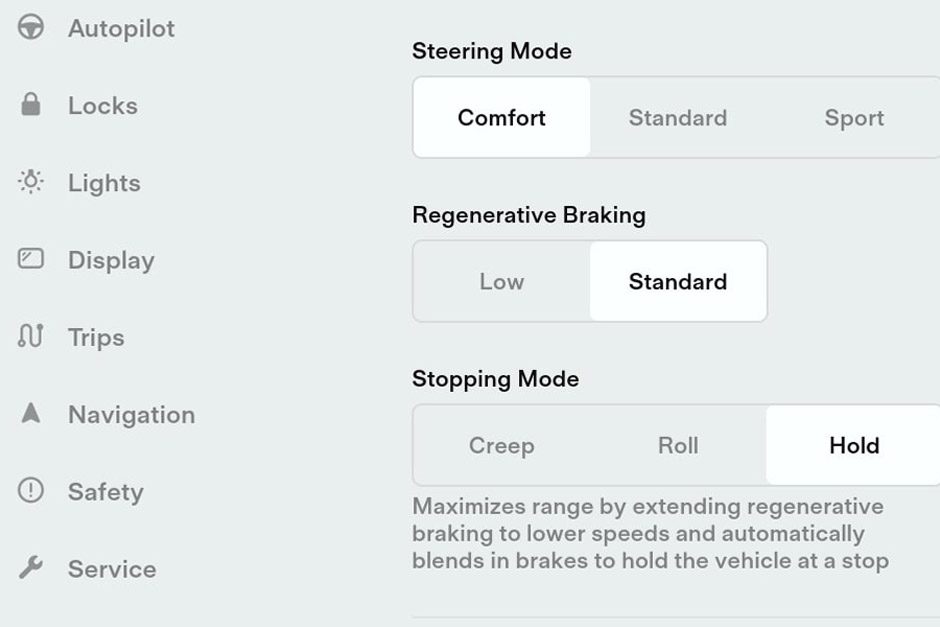
If you prefer gentler one-pedal braking, set regenerative braking to “Low.” Then choose “Creep” for “Stopping Mode.” If you favor a more rapid deceleration effect, set regenerative braking to “Standard.” Then adjust stopping mode to “Hold.” For models that received over-the-air updates after September 2025, software version 2025.32 and above now supports “Roll Mode.” When you release the accelerator pedal, the vehicle coasts naturally like a traditional internal combustion engine vehicle. The regenerative braking system no longer intervenes.
Different modes suit different scenarios. “Hold” mode is ideal for congested urban traffic. It allows the vehicle to come to a complete stop automatically upon pedal release. “Creep” mode provides a driving experience closer to the idle coasting of conventional cars. This mode suits new drivers transitioning to EVs.
BYD’s regenerative braking setup is equally convenient. On the center display, locate “Vehicle Settings.” Enter the “Drive” or “Powertrain” related options. There you will find the “Regenerative Braking Intensity” adjustment function. Typically, two settings are available: “Standard” and “High.”
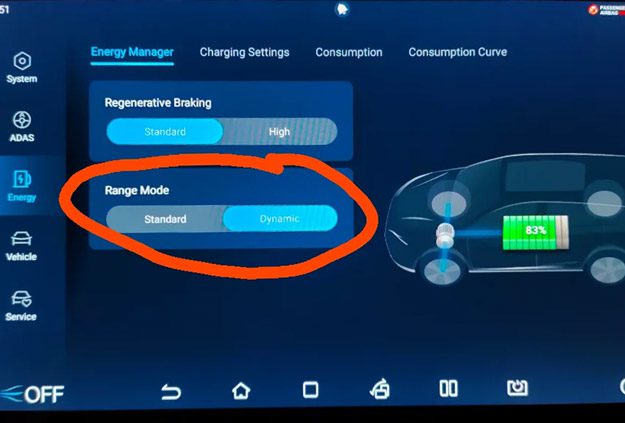
In Standard mode, deceleration upon throttle release is smooth and comfortable for passengers. High mode improves energy recovery efficiency. However, the deceleration sensation is more pronounced and may require gradual adaptation. For some models, such as the Song Pro DM-i, regenerative braking intensity automatically links to the driving mode. It is strongest in Eco mode, moderate in Comfort mode, and weakest in Sport mode.
According to real-world owner tests, using High regenerative mode on long downhill stretches can recover approximately 5% more energy than Standard mode. Additionally, enabling ECO mode combined with maximum regenerative braking can reduce energy consumption by about 1.8 kWh per 100 kilometers.
NIO vehicles allow owners to configure regenerative braking settings via the center display. Enter the “Settings” interface. Click on “Driver Assistance.” Locate the regenerative braking setting. Typically, three levels—High, Medium, and Low—are available. Owners can choose according to personal preference. For daily driving, we recommend selecting Comfort mode while increasing regenerative braking intensity. This balances energy savings and comfort.
XPeng offers two levels of regenerative braking intensity adjustment—High and Low. It also features the unique X-Pedal one-pedal mode. In X-Pedal mode, releasing the accelerator pedal triggers regenerative braking and deceleration. The instrument panel displays an ECO mode indicator. The deceleration process is linear and smooth. We advise new drivers to start with a low regenerative braking level. They can gradually increase it as they become accustomed.
Energy-saving mode minimizes energy consumption. It limits maximum power output, smooths accelerator response, and optimizes auxiliary systems such as air conditioning. In ECO mode, the electric motor typically delivers only 70% to 80% of its total available power. This results in more gradual acceleration and avoids abrupt energy expenditure.
Real-world data shows that ECO mode can help electric vehicles increase driving range by 10% to 15% in urban driving conditions. Take the 2025 BYD Seal as an example. One owner conducted a 10-day, 2,035-kilometer long-distance test. They found that the ECO mode delivered a full-charge range exceeding 450 kilometers. Normal mode yielded only about 375 kilometers. That is a difference of up to 20%.
We recommend prioritizing ECO mode in the following scenarios:
In contrast, Sport mode maximizes torque output and weakens or disables regenerative braking. This results in energy consumption that may be 15% to 25% higher than ECO mode. Therefore, judicious selection of driving modes in daily use can significantly enhance overall vehicle efficiency.
Correct vehicle settings are important. Driving habits are equally important. The following tips can help you further optimize energy efficiency:
Properly configuring regenerative braking and energy-saving modes is key for every electric vehicle owner. It helps extend range and reduce vehicle operating costs. Tesla, BYD, NIO, XPeng, and other brands offer flexible and diverse setup options. You can adjust settings freely according to road conditions and personal driving habits. In daily driving, certain habits yield tangible improvements in driving range. These habits include anticipating deceleration, accelerating smoothly, and making good use of auxiliary energy-saving features.

